Published on 24.03.2026
Helmholtz Imaging Newsletter Issue No. 26
Dear Imaging Enthusiast,
In this issue of the Helmholtz Imaging Newsletter, we highlight new opportunities to get involved, share your work, and shape the future of imaging science across the Helmholtz Association.
Two major calls are now open: the Helmholtz Imaging Project Call 2026, inviting bold, cross-disciplinary research proposals, and the Helmholtz Imaging Best Scientific Image Contest 2026, looking for striking scientific images. Whether you are developing new methods or capturing fascinating visuals of your research, we encourage you to take part.
Want to join our team? We are currently looking for a Team Lead at DKFZ, an exciting opportunity to lead a dedicated support and research team and shape data curation activities across Helmholtz. This role sits right at the intersection of data quality, infrastructure, and AI, contributing to robust, reusable imaging datasets that enable impactful research. We’re a motivated and collaborative team and would love to welcome a new colleague eager to advance imaging science with us.
Beyond these opportunities, we share updates from across the community, including new team members, highlights from ongoing projects, and selected tools and resources.
- Best Scientific Image Contest 2026: Submit your most compelling scientific images by May 1, 2026
- Helmholtz Imaging Project Call 2026: Apply for funding for collaborative, cross-disciplinary imaging research by June 26, 2026
- Team Updates: Welcomes and farewells across the Helmholtz Imaging team
- CONNECT Highlight: Evaluating motion and registration in adaptive radiotherapy
- Tools & Resources: LUCYD for restoring volumetric microscopy images
- Call for Experts: Join the SCIANCE Working Groups and help shape the future of AI in science across Europe.
- Lecture: When AI performance misleads – now available for streaming
- In the Media: Imaging research featured on ZDF’s Terra X
- Meet Us: Say hello at upcoming events in Munich, Nagoya and Leipzig.
- Partner Platform Updates: Events from HMC
- Funding, Events & Opportunities: Explore current calls, external events, recent publications, and job postings, including a position with our own team
As always, we welcome your contributions. Share your imaging-related news and events with us at support@helmholtz-imaging.de. Let’s keep building our vibrant imaging community together.
Happy reading!
Your Helmholtz Imaging team
***
A personal note from us:
Do you have an imaging challenge, no matter how big or small? Professional imaging support for Helmholtz researchers, offered by Helmholtz Imaging at no cost. Contact us via our support hub.
Also, if you haven’t yet, join our network of experts, modalities, instruments, and facilities! CONNECT with us.
Interested in receiving our newsletter directly in your mailbox? Subscribe here.
Visit our Helmholtz Model Zoo, the new platform for Helmholtz employees for AI-powered research: easy access, user-friendly, strong data protection, and a growing set of validated models from different domains. Join the community!
***
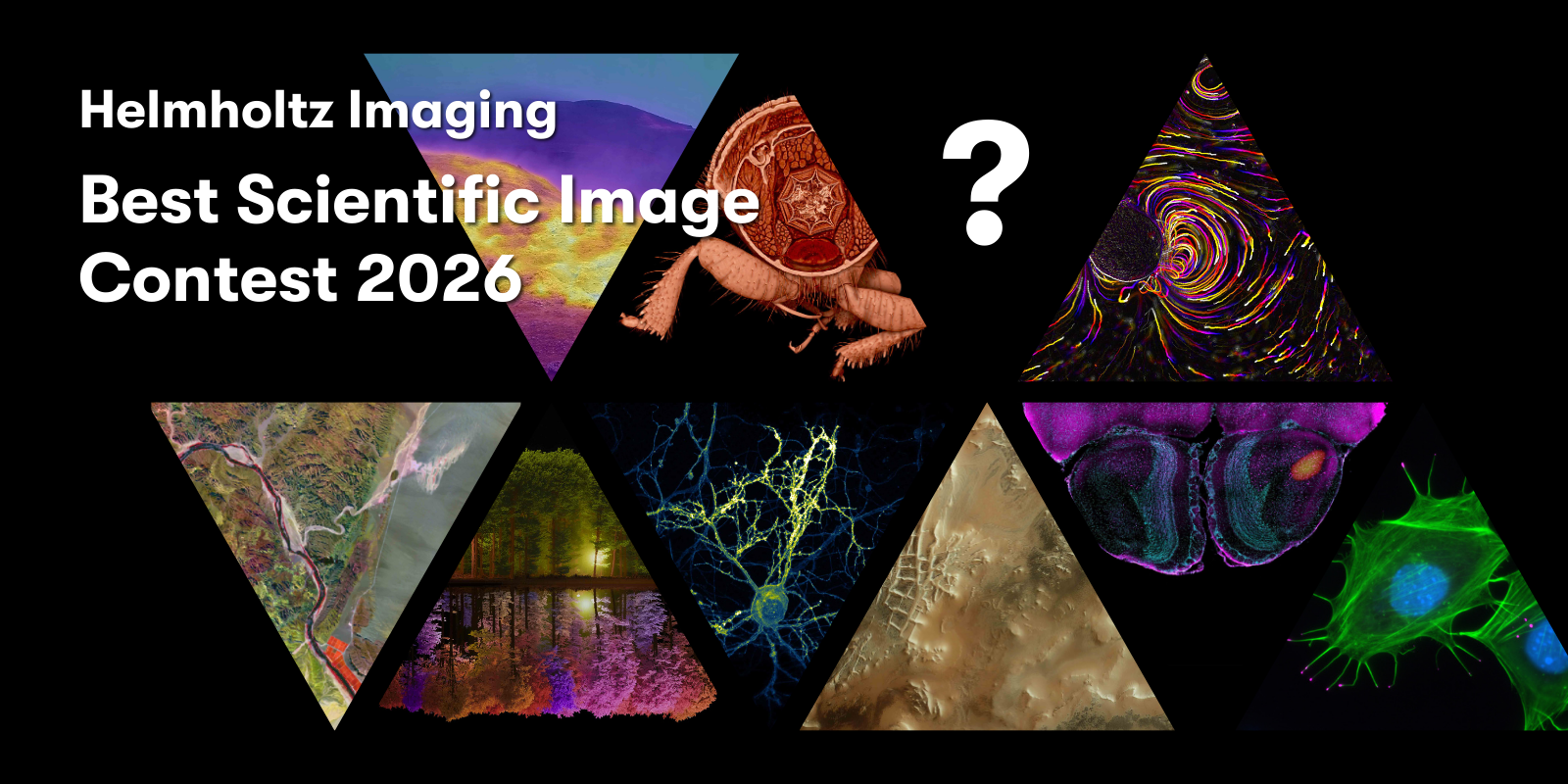
Helmholtz Imaging Best Scientific Image Contest 2026: Call is Open
What does your research look like? Submit your most captivating scientific images and showcase your research through the power of imaging. The deadline for submissions is May 1, 2026. Previously submitted images are welcome.
Compete for prestigious awards, attractive prizes and wide visibility within and beyond the Helmholtz community, including a feature in the Helmholtz Imaging traveling exhibition.
New this year: In addition to these prizes, winners will receive an exclusive consulting session with our Support Hub team to explore how Helmholtz Imaging can support and extend their research, ranging from image acquisition to advanced image analysis and AI methods. While our Support Hub is always available to all Helmholtz researchers at no costs via our support system, this dedicated exchange offers a uniquely focused and hands-on experience to spark new ideas.
Winning images can also attract media attention: for example, the image “Rare Earth Element Fern” by Kathryn Spiers and Dennis Brückner from DESY and collaborators, awarded in the 2025 contest, was recently featured in GEO magazine.
The award ceremony will take place at the Helmholtz Imaging Conference 2026 in the week of November 9-13 in Leipzig.
Learn more about the call & how to submit your images
Helmholtz Imaging Project Call 2026 – Now Open
Researchers from across the Helmholtz Association: submit your proposals for collaborative, cross-disciplinary, high-risk research projects at the intersection of imaging and information & data science! Selected projects can receive up to €500,000 in funding volume for up to three years (max. €250,000 from the Helmholtz Initiative and Networking Fund, matched by project partners). Additional funding is available for solutions that can be generalized across scientific domains.
Application deadline: June 26, 2026
Planning a proposal? Get in touch with the Helmholtz Imaging Support Hub already at the application stage. Whether you are looking to refine your approach, explore new ideas, or complement your expertise, we are here to support you.
Join either of our information sessions to learn more about this call, the application process, and ask any question you may have.
- Friday, April 24 at 10-11:30 AM CEST, agenda & registration
- Tuesday, June 2 at 10-11:30 AM CEST, agenda & registration
If you are looking for project partners or would like to exchange project ideas, join our dedicated “Helmholtz Imaging Project Call Matchmaking” channel on Mattermost.
Learn more and access the application documents on our website
Team Updates: Welcomes & Goodbyes
We are delighted to welcome Kris Dreher as the new Team Lead of the Helmholtz Imaging Engineering and Support Unit at DKFZ. With Kris on board, we look forward to continuing and strengthening the unit’s mission of supporting researchers with cutting-edge imaging and data science expertise.
At the same time, we would like to sincerely thank Fabian Isensee for four years of dedicated leadership of the Support Unit at DKFZ. His vision and collaborative spirit helped shape the team and its connections across the Helmholtz Imaging network. While we are sorry to see him step down from this role, we are glad that he will continue his work at DKFZ, remain active in the scientific environment, and stay closely connected to Helmholtz Imaging and the broader community.
We are also happy to welcome Thomas Roßberg, who recently joined the Helmholtz Imaging Engineering and Support Unit at MDC as a Research Software Engineer. Thomas brings expertise in Earth observation data, satellite imagery, and large-scale data processing. At Helmholtz Imaging, he will contribute to developing software such as PixelPatrol and support scientists involved in large-scale data processing and visualization.
Finally, we say farewell to Jan Philipp Albrecht, a valued member of the Support Unit at MDC and a driving force behind multiple open-source packages for our community, such as Polarity-JaM and Album. We thank him for his contributions and wish him all the best for his next steps.
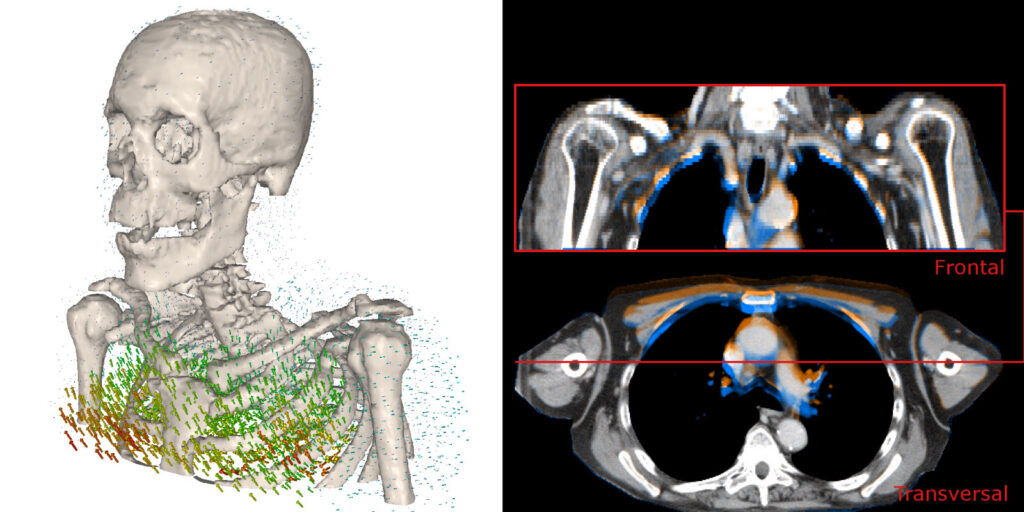
New on CONNECT: Evaluating Motion and Registration in Adaptive Radiotherapy
Modern radiotherapy can deliver radiation with remarkable precision. However, in areas such as the thorax, breathing motion causes tumors and surrounding organs to move in complex ways, making accurate imaging and dose delivery more challenging.
In a new blog post on the Helmholtz Imaging CONNECT platform, Richard Häcker explores how these challenges affect adaptive radiotherapy and the evaluation of medical image registration methods. Using lung radiotherapy as an example, the article highlights how even small misalignments between CT and MRI scans can influence dose calculations and biomarker analysis.
The post also discusses how learned image representations and new evaluation metrics could improve the assessment of motion and registration algorithms when ground truth data is unavailable.
Read the full blog post on CONNECT
This work was carried out within the Helmholtz Imaging project CLARITY.

Tools & Resources, from the Community, for the Community
Following your feedback from the last Helmholtz Imaging Conference, where you asked for more tools and resources, we introduced this new newsletter section dedicated to sharing open, practical solutions from the community. So, here we go:
Tool spotlight: LUCYD, restoration of volumetric microscopy images
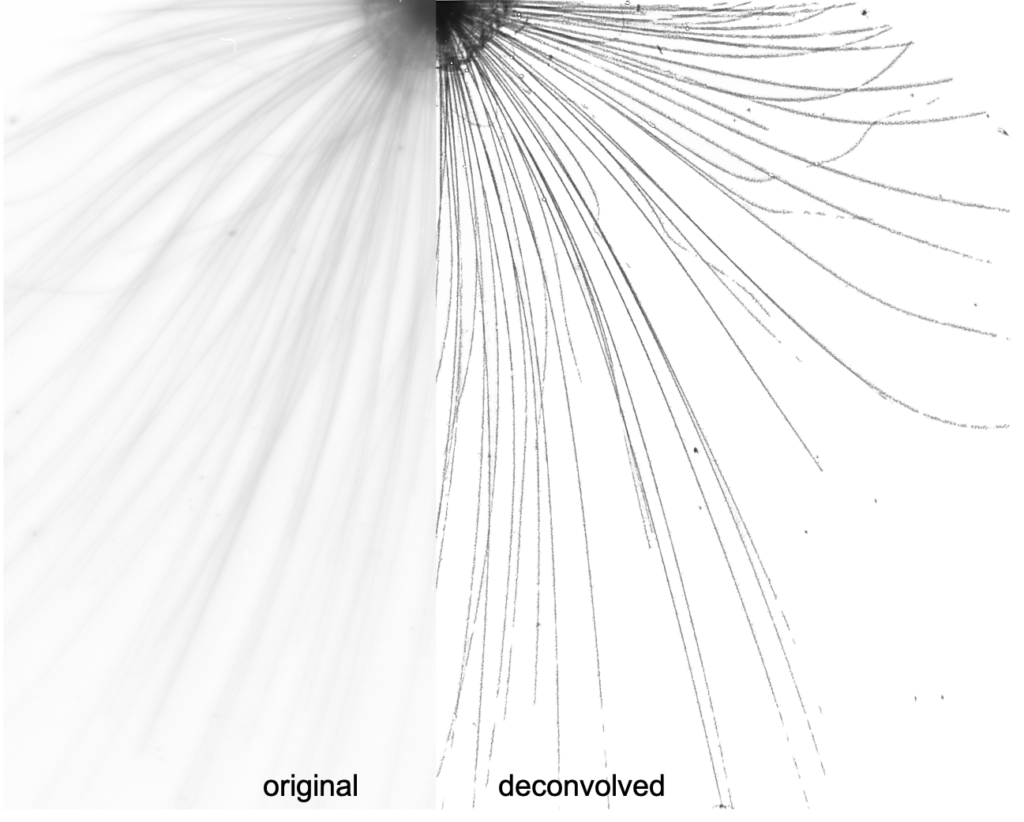
How can we recover useful information from noisy and blurred microscopy images? LUCYD is a new method for restoring volumetric microscopy images that combines the Richardson–Lucy deconvolution approach with deep feature fusion from a fully convolutional network. By integrating the image formation process into a feature-driven restoration model, LUCYD aims to improve image quality while reducing computational costs and maintaining interpretability.
The tool was developed by Tomáš Chobola, Gesine Müller, Veit Dausmann, Anton Theileis, Jan Taucher, Jan Huisken, and Tingying Peng.
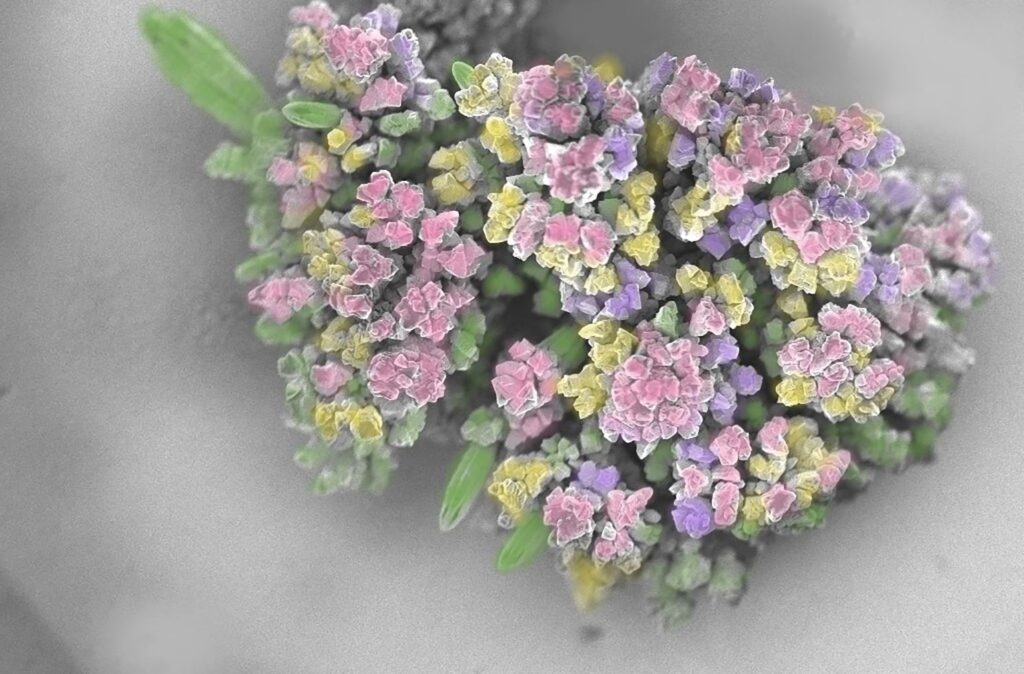
Image: Veit Dausmann, Geomar (living foraminifera captured with a PIScO (Plankton Imaging with Scanning Optics) underwater camera in the deep tropical Atlantic)
Have a tool, dataset, software package, or other resource you’d like to share? Submit your solution via CONNECT and help grow the collection of open and easy-to-use imaging resources. We look forward to featuring more community-driven tools in upcoming issues!
Call for Experts: Contribute to Europe’s AI-in-Science Agenda
The Horizon Europe-funded SCIANCE initiative invites experts to join its AI in Science Working Groups, a unique opportunity to help shape the future of AI in scientific research across Europe. SCIANCE contributes to building RAISE (Resource for AI Science in Europe), a virtual research institute for excellent European research on and with AI – including AI-driven imaging and image data analysis – providing European researchers with access to expertise, data, and computational resources.
Selected participants will contribute to the development of a Strategic Research & Innovation Agenda (SRIA), identifying priorities, challenges, and opportunities at the intersection of AI and science, naturally with a strong focus on data- and image-intensive research domains.
The working groups bring together interdisciplinary expertise to address key topics such as AI methods and tools, research infrastructures, data stewardship, and domain-specific applications, including imaging workflows and multimodal data integration.
If you are a recognized expert, emerging leader, infrastructure operator, AI innovator, or cross-disciplinary researcher working with imaging data across domains, and want to shape European AI in science priorities at policy and infrastructure level, consider applying. The deadline is April 10. 2026.
We would also be very happy to hear from you if you apply – and especially if you are selected to join one of the working groups.
More information & application

When AI Performance Misleads: Watch Annika Reinke’s Lecture
Strong results on paper do not always translate into reliable performance in practice. In her lecture “When AI Performance Misleads: From Success in Papers to Failure in Practice,” Annika Reinke discusses why AI models can fail when deployed in real-world settings. The talk highlights common validation pitfalls and offers practical guidance for improving the reliability and trustworthiness of AI systems.
Watch the full recording on HIDA’s YouTube channel
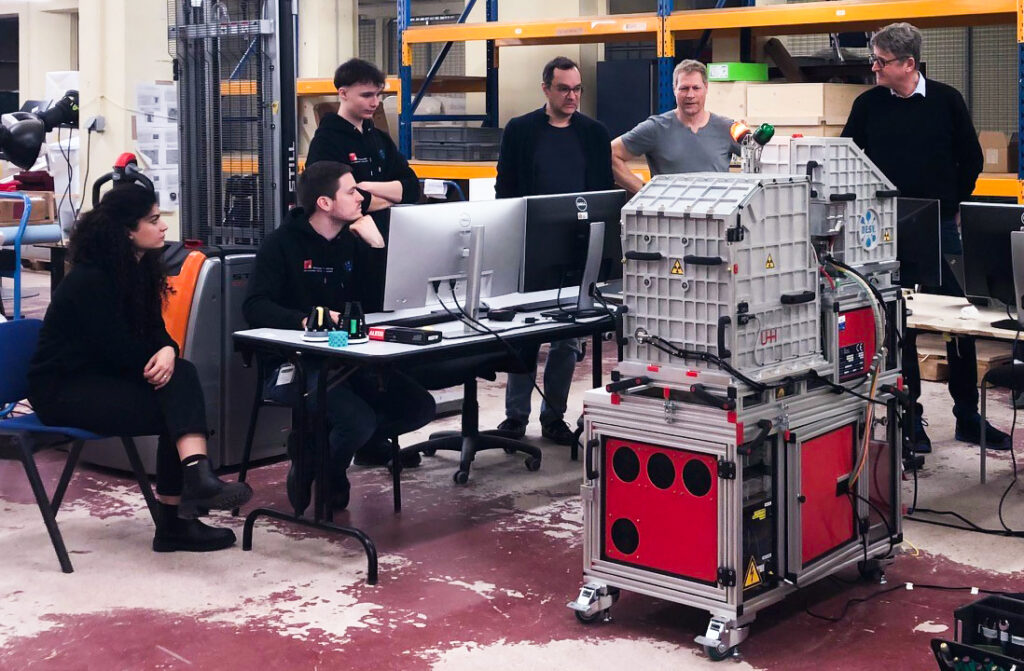
DESY Imaging Technology Featured on ZDF’s Terra X
How can scientists read texts that have remained hidden for thousands of years? A recent Terra X episode showcases how advanced imaging technologies make this possible. Christian Schroer, one of Helmholtz Imaging’s Center Coordinators, and colleagues from DESY, the University of Hamburg and use a mobile X-ray scanner to look inside sealed Mesopotamian clay envelopes – without opening them – revealing ancient cuneiform tablets.
A fascinating example of how interdisciplinary research unlocks the secrets of the past.
Watch the full story on ZDF (in German)
Meet Helmholtz Imaging
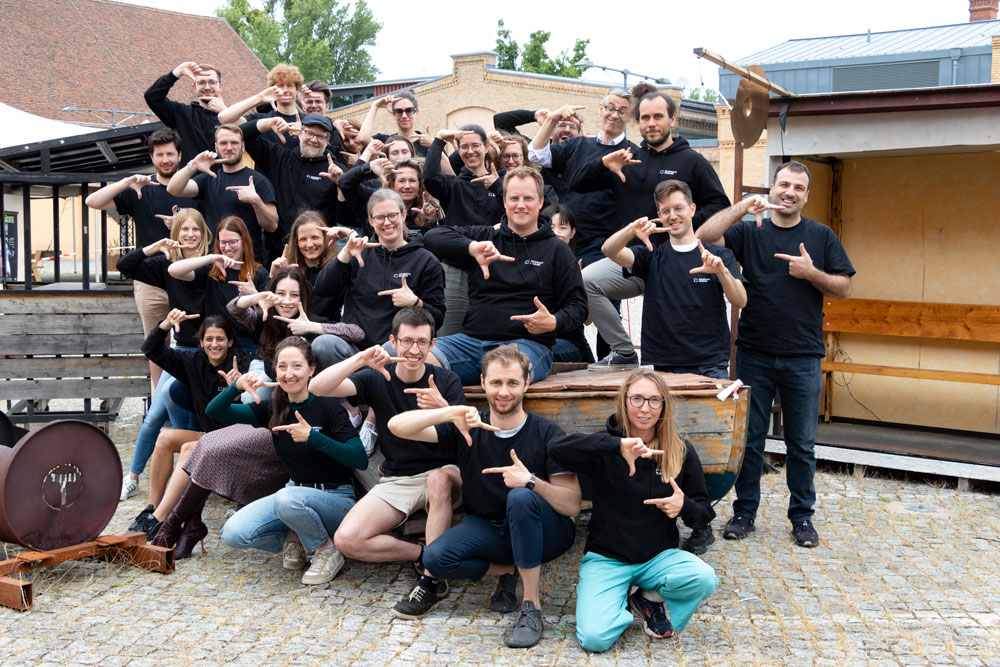
Say hello to Helmholtz Imaging team members at the following events:
- Say hello to many of us at HAICON26 on June 8-11 in Munich. Registration will open soon.
- Meet Carlos from the Research Unit at DKFZ at IPCAI 2026 on July 2-3 in Nagoya (Japan) where he’ll present the tool Claims Reloaded.
- Meet us at our next Helmholtz Imaging Conference in the week of November 9-13, 2026 in Leipzig. Stay tuned for more information.
News from our Partner Platform HMC
Registration Open: HMC Conference 2026
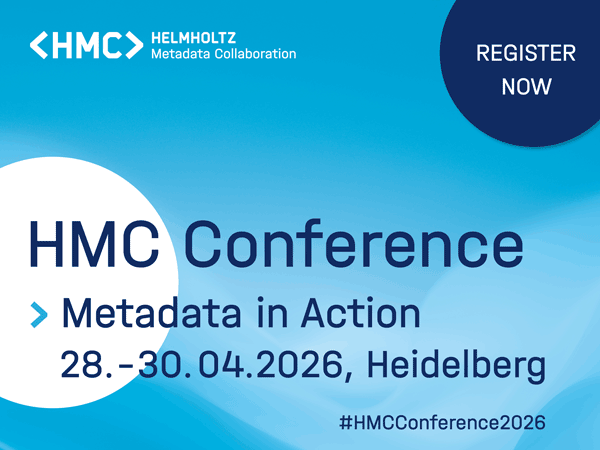
Over 100 submissions, inspiring keynotes, vibrant discussions, and a dynamic community: the HMC Conference 2026 – Metadata in Action will take place April 28-30, 2026 in Heidelberg. Registration is now open – secure your place and join us for three days dedicated to advancing metadata and FAIR research practices.
Metadata Questions? We’re Here to Help!
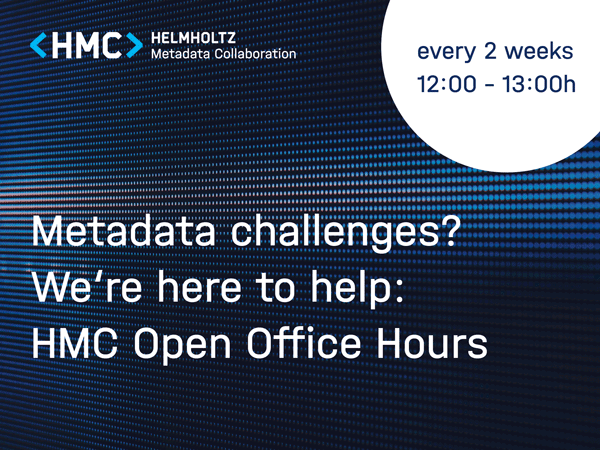
Big or small, technical or conceptual – bring your metadata questions to HMC’s Open Office Hours. Hosted by different HMC units, our sessions offer free, hands-on guidance from experts across Helmholtz.

Funding Opportunities
Helmholtz Software Award 2026: Recognition of outstanding contributions of software developers across Helmholtz in three categories: Best Scientific Software, Sustainability, Newcomer. Nomination deadline: April 17, 2026.
Next Frontier AI Challenge: SPRIND – the German Federal Agency for Breakthrough Innovation – is running a challenge to build three European frontier AI labs. Deadline: May 31, 2026.
Nature Awards AI for Discovery: Are you a researcher harnessing AI and machine intelligence to solve pressing challenges in health, the environment, and industry? Consider applying! Deadline: May 27, 2026.
External events
- Live webinar on Volkswagen Foundation’s funding portfolio: April 9, 2026, registration not required
- Introduction to image processing and analysis with Fiji/ImageJ and other analysis freeware workshop: April 7-May 22, every Tuesday & Friday, virtual; to register email Matthieu Vermeren
- 2026 ESRIC Specialist school: May 11-15, 2026, Edinburgh, costs: £100, limited to 15 participants
- E-Heraeus Summer School “Physics of imaging: Holography, Ptychography, Tomography et al. & AI”: July 5-10, 2026 in Bad Honnef, registration is open
- IJCAI-ECAI 2026, the 35th International Joint Conference on Artificial Intelligence: August 15-21, 2026, Bremen, calls for workshops, demonstrations & tutorials are open (deadlines vary)
- 16th XTOP Biennial Conference on High-Resolution X-Ray Diffraction and Imaging: September 21-25, 2026, Karlsruhe, save the date.
Do you know of any imaging-related events that could be of interest to our imaging community? We’d love to hear from you. Share the details with us at support@helmholtz-imaging.de.

New publications
Explainable AI-based analysis of human pancreas sections identifies traits of type 2 diabetes by Lukas Klein et al.
ToothSeg: Robust Tooth Instance Segmentation and Numbering in CBCT using Deep Learning and Self-Correction by Niels van Nistelrooij et al. Repository: Explore on GitHub
Adversarial flows: A gradient flow characterization of adversarial attacks by Lukas Weigand et al.
Accepted at IPCAI 2026: Current validation practice undermines surgical AI development by Annika Reinke et al. & Claims Reloaded (the tool is freely available)
Discover all publications by Helmholtz Imaging
Job openings
Helmholtz Association
Helmholtz Imaging at DKFZ
Team Lead Position “Data Curation Unit”
DESY
Postdoc in Particle Accelerator Physics
FZ Jülich
Scientist / Postdoc – Smart Vision-Based Control of Microbial Arenas
Geomar
Postdoctoral researcher (m/f/d) in ocean-biogeochemical modelling
Helmholtz Munich
Agentic AI Research Engineer (f/m/x)
External
Universität Hamburg
Research Associate for the Project “Cluster of Excellence ‚CUI: Advanced Imaging of Matter‘- Studying dynamical superfluidity in model systems”
Universität Freiburg
Research position: Visualizing 3D failure mechanisms with X-Ray imaging and Artificial Intelligence
University of Münster & the Max Planck Institute for Molecular Biomedicine
CiM-IMPRS Graduate Program (training in life sciences and natural sciences, with focus on the use of different imaging technologies to address biological or biomedical questions)
University of Northhampton
Senior Microscopist and Facility Manager