Our Research
The Helmholtz Association’s research fields tackle the major challenges and pressing issues facing society and develop sustainable solutions for tomorrow and beyond. As an enabler, Helmholtz Imaging will foster the interdisciplinary development and use of imaging methods and modalities.
Helmholtz Imaging’s research is based on a cross-community and cross-research-field approach that provides a unique opportunity to combine the skills and strengths of individual researchers and centers for the benefit of the entire Association.
Helmholtz Imaging has three research units that cover the entire imaging pipeline, from data acquisition to data integration to data analysis. Each part of this imaging process is associated with specific scientific challenges and research software tools. Expertise on all these issues is available in the Helmholtz community. Helmholtz Imaging aims to leverage this treasure of knowledge while simultaneously enriching it with new research results.
Helmholtz Imaging’s publications reflect this diversity, featuring unique data sets, ready-to-use software tools, and cutting-edge research papers from the three Research Units, funded Helmholtz Imaging Projects, supervised theses, and Helmholtz Imaging Collaborations.
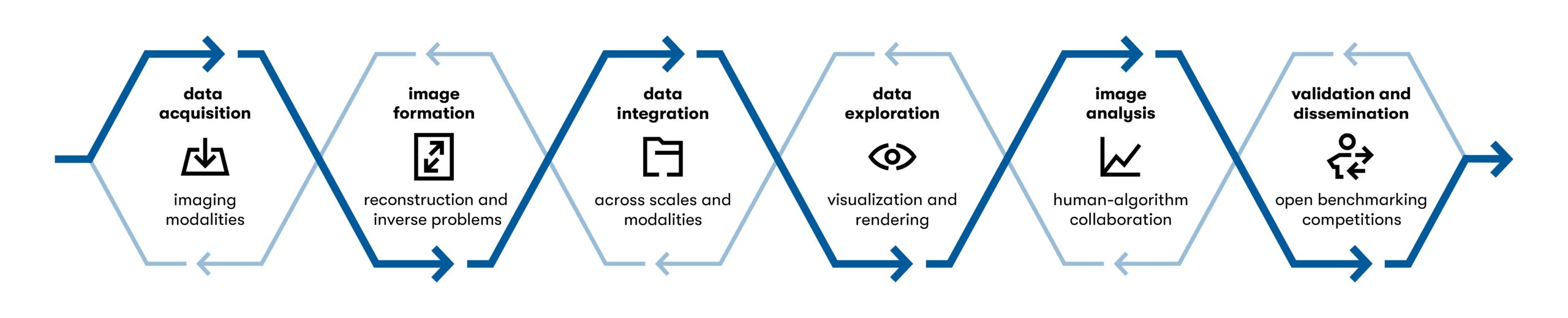
The Research Unit at DESY focuses on the early stages of the imaging pipeline, developing methods for advanced image reconstruction, including the optimization of measurements and the combination of classical methods with data-driven approaches. Our goal is to drag out a maximal amount of (quantitative) information from given or designed measurements.
The Research Unit at MDC focuses on integrating heterogeneous imaging data across modalities, scales, and time. We develop concepts and algorithms for generic processing, stitching, fusion, and visualization of large, high-dimensional datasets. Our aim is to enable seamless analysis of complex imaging data without restrictions on the underlying modalities.
The Research Unit at DKFZ focuses on the downstream stages of the imaging pipeline, developing robust methods for automated image analysis and emphasizing rigorous validation. Our goal is to enable trustworthy and generalizable AI across scientific imaging domains.
Model-based Inverse Design
Inverse Problems: we focus on problems at the beginning of the imaging pipeline related to data acquisition and image formation. This is a crucial step in the pipeline, since information lost or not measured at this stage can hardly be recovered in later stages.
In the data acquisition, the change of some emitted signal interacting with the sample is measured. In order to produce meaningful images, an image reconstruction step is necessary. To achieve this task a mathematical model of the forward process leading to data generation has to be developed and then inverted to compute the image of interest. This process is called an inverse problem, whose stable solution relies on further a-priori knowledge or even training data about the type of images to be reconstructed. The development of algorithms for image reconstruction with highest quality is a major research topic for us.
The quality of the reconstructions is controlled via uncertainty quantification methods and feedback to the data acquisition is given by optimal experimental design techniques. Further important research questions investigated concern the compression of large scale data as well as problems at the edge to further steps in the pipeline such as denoising and registration.
Integrative Imaging Data Sciences
Integrative imaging data sciences: we focus on integrating heterogeneous imaging data across modalities, scales, and time. They develop concepts and algorithms for generic processing, stitching, fusion, and visualization of large, high-dimensional datasets.
The amount of image data, algorithms and visualization solutions is growing vastly. This results in the urgent demand for integration across multiple modalities and scales in space and time. We develop and provide HI solutions that can handle the very heterogeneous image data from the research areas of the Helmholtz Association without imposing restrictions on the respective image modalities. To lay the groundwork for the implementation of HI solutions, our team at MDC will focus on the following research topics:
- Develop concepts and algorithms for handling and generic processing of high-dimensional datasets.
- Develop algorithms for large, high-dimensional image data stitching, fusion and visualization
Our “Integrative Imaging Data Science” Group specializes on new concepts, mathematical approaches and representations for large scale image data. Our work includes the development of algorithms, computational resources and visualization solutions across scales in space, time and modalities. We bundle expertise in:
- concepts and algorithms for handling, generic processing and representation of high-dimensional datasets
- image analysis and visualization across scales
- frameworks for large data management, image analysis and data abstraction
Image Analysis & Benchmarking
Image Analysis & Validation (DKFZ): we focus on the downstream stages of the imaging pipeline – specifically, the development, validation, and deployment of advanced AI-based methods for automated image analysis. These phases are critical for extracting high-level, domain-relevant information from complex imaging data. Our work addresses algorithmic challenges in interpreting, quantifying, and validating image-derived information, with the overarching goal of enabling trustworthy, robust, and generalizable AI-driven analysis.
We conduct interdisciplinary research in three core areas:
(1) automated image analysis, where we work to enhance the robustness and generalizability of AI methods across diverse and imperfect real-world datasets;
(2) human-machine interaction, which aims to integrate humans as active participants in AI development and deployment to ensure transparency, trust, and safety; and
(3) validation and benchmarking, where we lead efforts to develop and standardize validation practices and develop tools that enable reproducible and transparent assessments of algorithm performance.
By addressing these pivotal stages in the imaging pipeline, our mission is to advance the reliability and impact of AI-based image analysis across scientific and societal applications.

Helmholtz Imaging captures the world of science. Discover unique data sets, ready-to-use software tools, and top-level research papers. The platform’s output originates from our research groups as well as from projects funded by us, theses supervised by us and collaborations initiated through us. Altogether, this showcases the whole diversity of Helmholtz Imaging.
Read moreOther Services
Support Hub
The Support Hub is your gateway to the world of Helmholtz Imaging! Simply send an e-mail to support@helmholtz-imaging.de and we will help you out. Any request is welcome, whether it is a question about administrative or imaging-related matters, consulting requests, project support, Helmholtz Imaging Collaborations or access to our portfolio.
CONNECT
Helmholtz Imaging CONNECT is the heart of the Helmholtz Imaging Network. Get to know the imaging experts from the Helmholtz Association, explore the amazing portfolio of cutting-edge instruments from satellites to synchrotrons, dive into the exciting world of imaging applications. Helmholtz Imaging CONNECT facilitates finding partners and collaborators for innovative projects, with just the right complementary expertise necessary to conduct research for grand challenges.
We want you! If you are affiliated to one of the Helmholtz Centers, we invite you to add your profile, your modalities and your applications to the website. Be Helmholtz Imaging!
Collaborations
Struggling with an imaging-related project? Apply for a Helmholtz Imaging Collaboration and tap into the expertise of Helmholtz Imaging! Collaborations enable you to team up with one of our units for an elongated period of time (up to 6 months or even longer) to work on a project together. Whether you require support in (AI-based) image analysis, image reconstruction, annotation, data management, software solutions, addressing inverse problems, developing novel imaging modalities, 3D visualization and more – we are your partner.
Software
Helmholtz Imaging provides consultation regarding existing software or methods, and make these resources available as easy-to-use Helmholtz Imaging Solutions to standardize and simplify the process of finding the right software to your research questions. We also develop, provide and maintain our own open source software solutions, which address the most challenging research questions in imaging science. Contact us if you need support using one of our software solutions!