Published on 20.11.2026
From Organoids to Earth Observation: Helmholtz Researchers Advance AI-Ready Scientific Data
Artificial intelligence is transforming scientific research. But even the most sophisticated AI models depend on one essential resource: high-quality data. Making scientific datasets accessible, well-structured and suitable for AI is therefore becoming increasingly important.
Recognizing this need, the German Research Foundation (DFG) has announced funding for 51 projects under its initiative “Data Corpora for Artificial Intelligence”, providing approximately €22 million over two years to develop high-quality data resources for AI research.
“Building a high-quality dataset takes months of imaging, expert annotation and documentation, and this work usually doesn’t fit into a classic research grant, where the data is only a means to an end and rarely gets curated beyond what the paper needs. The DFG program funds exactly this kind of infrastructure, and rewards this valuable work for itself.“ – Marie Piraud
Researchers from several Helmholtz Centers are among the successful applicants, including two scientists connected to the Helmholtz AI and Helmholtz Imaging community: Marie Piraud (Helmholtz Munich & Helmholtz AI, UNLOCK Project UQOB) and Ridvan Salih Kuzu (DLR, HI Project HYPER-AMPLIFAI).
From organoids to Earth observation: Building AI-ready datasets
The funded projects demonstrate the diversity of scientific data and the opportunities they offer for AI research.
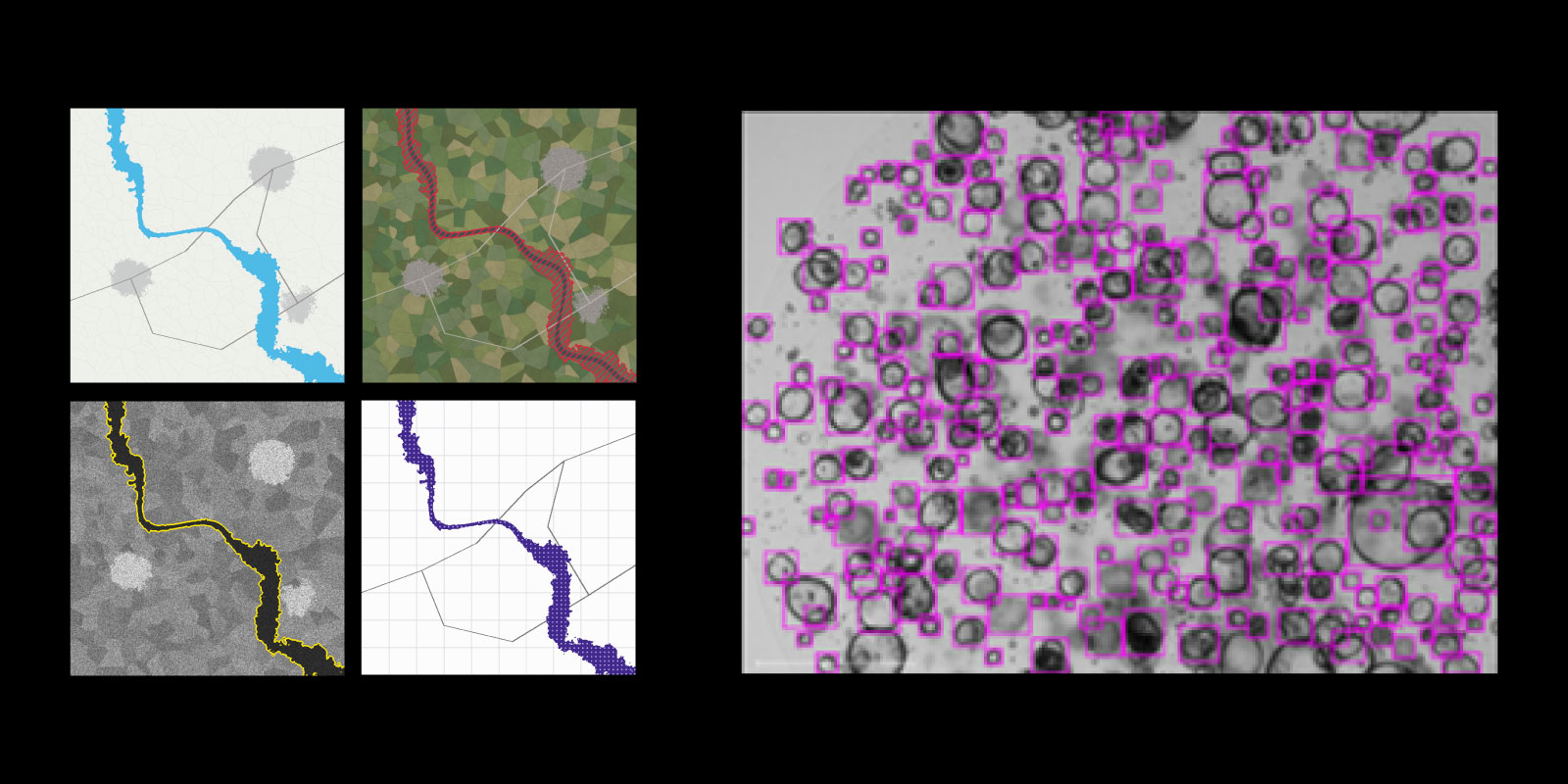
SCOPE-AI, involving Marie Piraud from Helmholtz Munich alongside partners from the University of Marburg and the German Cancer Research Center (DKFZ), aims to develop structured organoid datasets spanning different phenotypes and scales. By making these complex biological data resources available for AI research, the project seeks to create new opportunities for studying organoids and their applications.
“Many labs produce excellent organoid images, but the data mostly stays on local drives, because protocols, microscopes and file formats differ between labs, annotations are missing or inconsistent, and the effort of sharing them is rarely rewarded. As a result, most AI models are trained on small and fairly homogeneous datasets and often fail as soon as the conditions change. SCOPE-AI won’t solve this alone, but by defining shared annotation standards, documenting the metadata consistently and publishing under open licenses, we hope to provide a reference others can build on,” says Marie Piraud.
Corp-EO, brings together Ridvan Salih Kuzu from the Remote Sensing Institute (MF-DAS) and Sandro Martinis from the German Remote Sensing Data Center (DFD-GZS), both located at DLR. The project focuses on developing AI-ready Earth observation data resources for disaster response, supporting the use of artificial intelligence in analyzing Earth observation data.
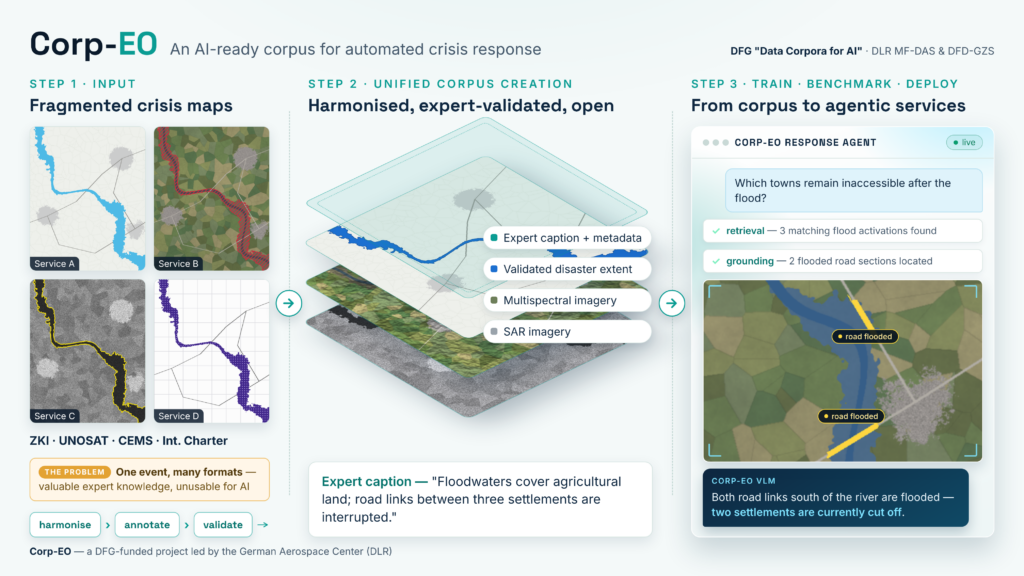
“The DFG funding lets us do something that rarely fits into either research or operations alone: it brings AI researchers and operational crisis-mapping experts around the same table for two years, to turn multi-year archives of expert work into a ‘gold standard’ resource for the whole community,” explains Ridvan Salih Kuzu.
Ridvan is also involved in the Helmholtz Imaging project HYPER-AMPLIFAI, which develops more accessible and computationally efficient visual foundation models for multi- and hyperspectral image analysis in agriculture and forestry. The project also aims to curate high-quality hyperspectral datasets and establish new benchmarks. While addressing different applications, both projects highlight the importance of high-quality Earth observation data for advancing AI research.
„HYPER-AMPLIFAI and Corp-EO are two stages of the same journey. In HYPER-AMPLIFAI, our Helmholtz Imaging project with GFZ, we gained profound experience in building and adapting foundation models for Earth observation from high-quality multi- and hyperspectral imagery. Corp-EO now carries this expertise forward: it grounds vision-language models — and, ultimately, agentic AI tool chains — in an expert-annotated disaster corpus, so that these capabilities serve disaster preparedness and response. Both projects reflect the same conviction: progress in AI for Earth observation depends as much on high-quality scientific data as on better models,“ says Ridvan.
Strengthening Data Quality and Benchmarking Across Helmholtz
Helmholtz Imaging is also strengthening its support for high-quality, AI-ready image datasets through its newly established Data Curation Unit. Bringing together expertise across four Helmholtz Centers, the unit helps researchers address challenges throughout the imaging data lifecycle, from metadata management and quality assessment to annotation and FAIR data publication. It also aims to develop reusable tools and workflows and establish high-quality flagship datasets that can serve as benchmarks for the research community.
The importance of reliable, reusable datasets is also reflected in the UNLOCK initiative that supports the development of standardized benchmarking datasets to improve the evaluation, comparability and reproducibility of AI methods.
Several UNLOCK projects bring together researchers who are also active in Helmholtz Imaging collaborations.
One example is UQOB, led by Marie Piraud, co-lead of SCOPE-AI (see above). The project is developing a benchmark dataset for object detection and uncertainty quantification in organoid microscopy images, featuring more than 120,000 organoids annotated by multiple experts. By accounting for differences between annotators, UQOB aims to improve the reliability and evaluation of AI models in biomedical imaging.
Another example is AMOEBE, led by Katharina Nöh from Forschungszentrum Jülich. It aims to establish a large-scale, FAIR benchmark dataset using high-resolution time-lapse microscopy of microbial communities. Katharina is also involved in several Helmholtz Imaging projects, including Vi(MA)²C, which combines computer vision and optical tweezers for automated manipulation of microbial communities at single-cell resolution.
Similarly, ForestUNLOCK, led by Stefan Kruse from the Alfred Wegener Institute, develops a multimodal benchmark dataset for monitoring boreal forests and assessing carbon stocks. Stefan also leads the Helmholtz Imaging project POINTR, which combines 3D radar and point cloud data to investigate structural changes in northern forests.
These examples demonstrate how researchers from the Helmholtz Imaging and Helmholtz AI community contribute to broader initiatives that aim to make scientific data more accessible, reusable and valuable for AI research.
Unlocking scientific data for the future
From biomedical imaging to Earth observation and environmental monitoring, these initiatives share a common goal: transforming valuable scientific data into reliable resources that researchers can use to develop, evaluate and improve AI methods.
Together, they demonstrate that advancing AI in science is not only about developing better algorithms. It is also about building the (image) datasets, benchmarks and collaborative research infrastructure that make new scientific discoveries possible.
Further information:
DFG: Data Corpora for Artificial Intelligence – funded projects
Helmholtz launches first UNLOCK benchmarking projects (news article)
Overview of Helmholtz Imaging projects
New Helmholtz Imaging Data Curation Unit (news article)