From Data to Impact: Helmholtz Imaging Shapes the MEDAL Project
Image: Envato Elements | info
A major milestone for AI in medical imaging: Lena Maier-Hein, Center Coordinator at Helmholtz Imaging and researcher at the German Cancer Research Center (DKFZ), has been awarded €3 million in funding from the Carl-Zeiss-Stiftung for the MEDAL project. Helmholtz Imaging will contribute its expertise in benchmarking image analysis AI models and their evaluation to help establish a global standard for evaluating AI systems.
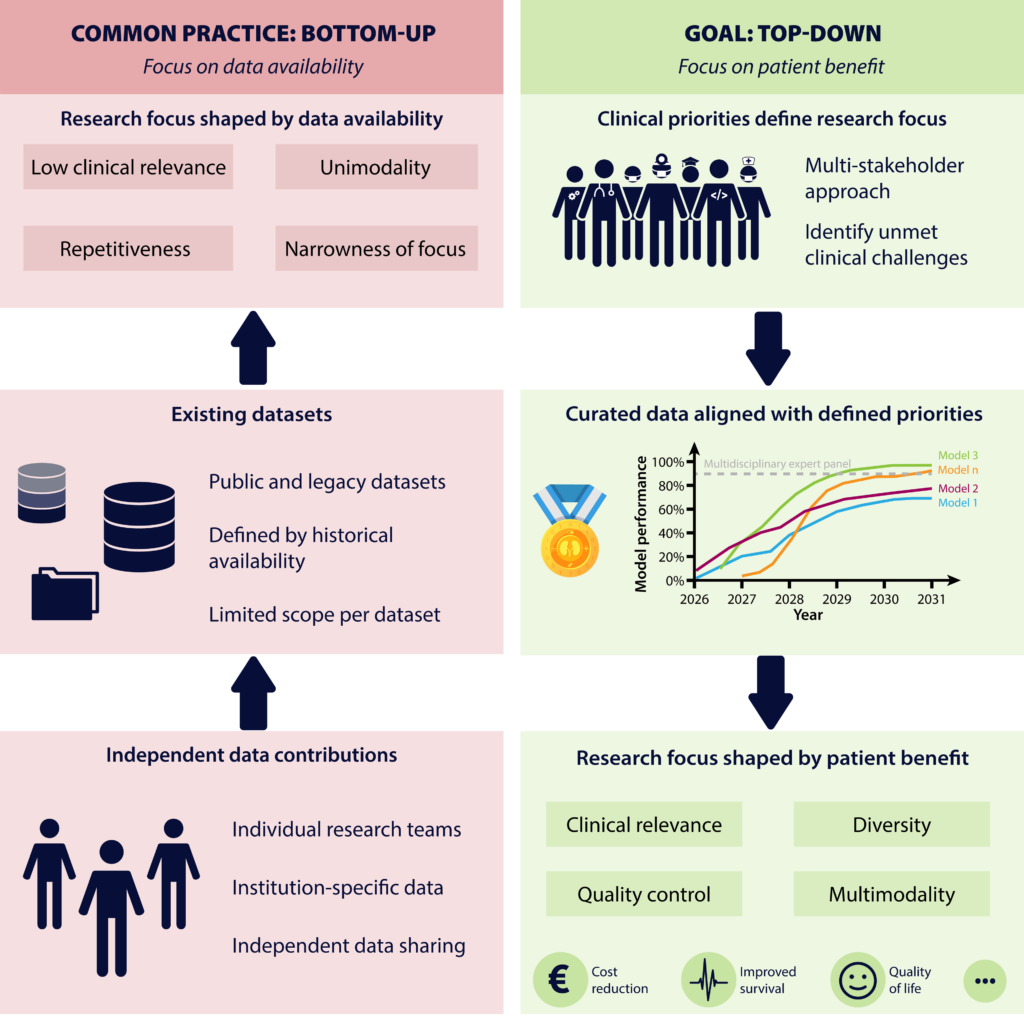
Artificial intelligence holds enormous promise for healthcare, ranging from early disease detection to therapy planning. Yet, current AI systems are often evaluated on datasets that fail to reflect real clinical complexity. As a result, research is frequently driven by available data rather than by the most urgent medical needs.
The MEDAL project (Medical Imaging AGI’s Last Exam) addresses this gap with an ambitious vision: to establish a global benchmark for clinically relevant AI in medical imaging. By combining multimodal data, including CT, MRI, pathology, and surgical video, with real-world clinical questions, MEDAL aims to create a “final exam” for medical AI.
“Data drives research—current analyses show that research topics in AI are often selected based on what data is available, rather than on which clinical problems need to be solved most urgently,” says project lead Lena Maier-Hein.
A global effort to redefine AI evaluation
At its core, MEDAL is a global effort. Through an international crowdsourcing initiative, experts are invited to submit pressing clinical challenges together with relevant datasets. An interdisciplinary panel will evaluate these contributions, shifting the focus from narrow technical benchmarks toward assessing whether AI can truly address complex medical problems.
“Current test datasets often merely reflect simple routine tasks, such as recognizing or outlining specific structures. They therefore reveal little about how well modern AI systems understand complex medical contexts or can function reliably in new situations,” says Annika Reinke, senior scientist and interim Head of Helmholtz Imaging Research Unit at DKFZ on the project.
Helmholtz Imaging’s expertise in benchmarking image analysis AI models
Helmholtz Imaging plays a central role in this endeavor to establish a benchmark for clinically relevant AI in medical imaging. With its expertise in benchmarking image analysis AI models and evaluation, it contributes key methodologies for structuring how clinical questions and datasets are defined, submitted, and assessed. By developing robust and transparent evaluation frameworks, Helmholtz Imaging helps ensure that AI systems are tested against meaningful, clinically relevant challenges.
Beyond Medicine: Impact across Domains
This contribution extends beyond medical imaging. The benchmarking approaches developed within MEDAL are transferable across domains, providing a blueprint for evaluating AI systems beyond medical imaging and across the Helmholtz Association. In this way, Helmholtz Imaging strengthens the community’s role in shaping reliable and impactful AI.
“We thank the Carl-Zeiss-Stiftung for joining us on this unusual path. We hope to create a globally recognized standard with MEDAL to objectively measure the progress of medical AI,” says project leader Maier-Hein, adding: “Above all, however, MEDAL is intended to benefit patients by ensuring that future AI systems are specifically developed to address the most critical medical challenges.”
With MEDAL, DKFZ, Helmholtz Imaging and their partners are not only advancing the field of medical AI, but also helping redefine how progress in artificial intelligence is measured. The ultimate goal of improving patient care.
About the Carl-Zeiss-Stiftung The Carl-Zeiss-Stiftung funds science and teaching in the STEM disciplines of Science, Technology, Engineering, Mathematics. As a partner to outstanding science, it provides funding opportunities for basic and applied research. The foundation was established in 1889 by Ernst Abbe in Jena and is now one of the oldest and largest private research funding organizations in Germany. It is the sole owner of Carl Zeiss AG and SCHOTT AG. The funding activities are made possible by dividends from the two foundation companies.
We use cookies to ensure the proper functioning of our website. Privacy policy